
The Role and Growth Opportunities of “BESS Integrated with Renewable Energy”
erex Co., Ltd.
The Role and Growth Opportunities of “BESS Integrated with Renewable Energy”
within erex Group’s Aggregation Strategy
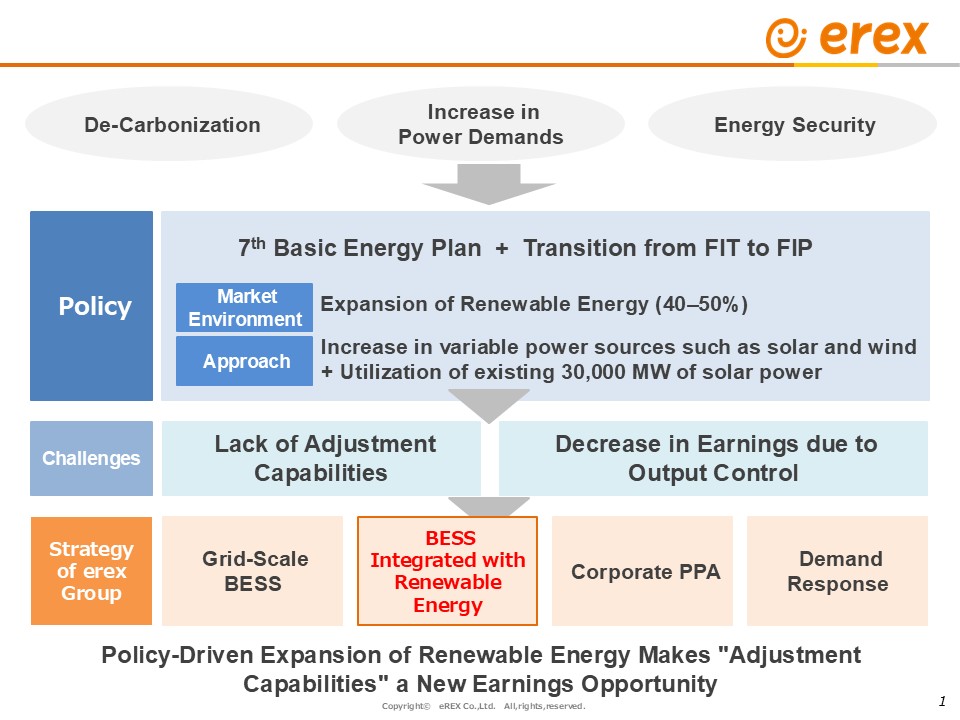
erex Co., Ltd. (Headquarters: Chuo-Ward, Tokyo, Representative Director & President: Hitoshi Honna; hereinafter referred to as “the Company”) positions its aggregation business, which combines diverse distributed power resources and provides them as supply/demand adjustment capabilities and market value, as a growth area, as announced in its mid-term business plan published on February 26, 2026. The Company is expanding this business by combining grid-scale BESS, BESS integrated with renewable energy, corporate PPA, demand response, etc. In this release, the Company outlines the role and growth opportunities of BESS integrated with renewable energy in particular.
1. Overview of the Company’s Aggregation Business
Aggregation business is a business that optimizes the balance of supply and demand of electric power by integrally controlling and operating distributed power resources such as renewable energy, BESS, and demand-side resources, thereby creating and providing value in the electric power market.
The Company develops its aggregation business based on the following four pillars:
- Grid-scale BESS
- BESS integrated with renewable energy
- Corporate PPA
- Demand response
By combining these distributed resources, the Company aims to provide supply/demand adjustment capabilities and maximize earnings opportunities in the electric power market.
2. Changes in Market Conditions and Policies
In recent years, the environment surrounding energy has become increasingly complex, driven by factors such as the progress of de-carbonization, increase in electric power demands due to the proliferation of AI and data centers, and the growing importance of energy security due to rising geopolitical risks.
In Japan, the 7th Strategic Energy Plan was approved by the Cabinet in February 2025, projecting that the electric power generation is expected to increase from 853.8 billion kWh with renewable energy ratio of 26.5% in fiscal year 2024 (preliminary figures) to 1,100-1,200 billion kWh with renewable energy ratio of around 40-50% by fiscal year 2040. Furthermore, with the full-scale operation of the GX-ETS (Emissions Trading Scheme) from April 2026, de-carbonization measures are strongly demanded from a regulatory perspective as well.
As renewable energy becomes the primary power source, the government is shifting from the Feed-in Tariff (FIT) system to the market-linked Feed-in Premium (FIP) system, transforming the market into one requiring sophisticated operational capabilities, including supply/demand adjustments.
Comparison of FIT and FIP
| FIT | FIP | |
| Mechanism (power selling price) | Generated power is purchased at a fixed price set by the government. Not affected by market prices. | The business operator sells power to the market or other businesses and receives a premium based on the difference between the benchmark price (FIP price) and the market price |
| Contribution to becoming a main power source | Initial adoption (expansion of introduction) | Making renewable energy a power source that works in the market |
| Barriers to entry | Low | High |
| Profitability | Fixed (stable profit) | FIT stable profit+variable profit |
3. The State of the Renewable Energy Market and the Role of BESS Integrated with Renewable Energy
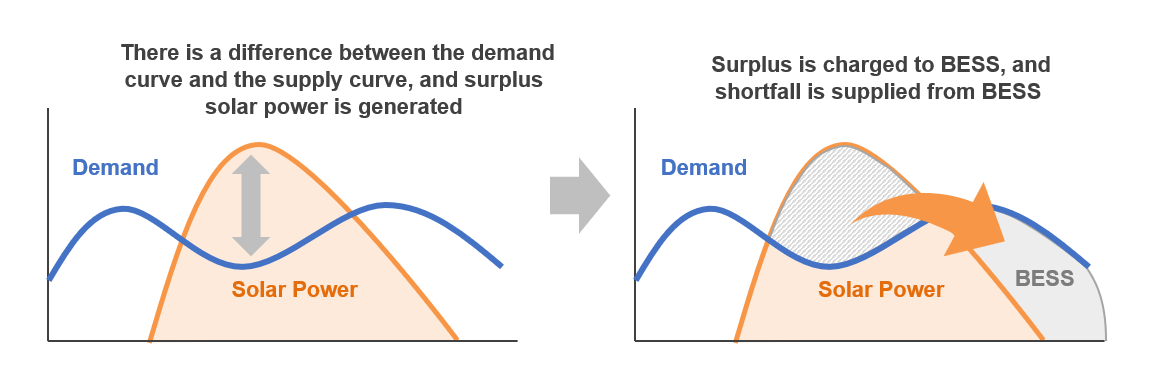
With the expansion of renewable energy introduction, a large market has formed in Japan for commercial solar power generation, with cumulative installations reaching approximately 30,000 MW (approximately 9,000 installations). On the other hand, fluctuations in renewable energy output due to weather and other factors are leading to increased surplus power and output control, making means of adjusting the balance between electric power supply and demand essential. Furthermore, the transition to the FIP (Feed-in Premium) system requires specialized expertise, particularly in supply and demand adjustment know-how, unlike the previous fixed-price electric power sales system.
In this market environment, BESS integrated with renewable energy plays the following roles;
- Stabilization of power supply by absorbing output fluctuations
- Effective use of renewable energy by avoiding output control
- Creation of earnings opportunities through charging and discharging according to market prices
This makes it possible to transform renewable energy sources from mere power generation facilities into “high-value power sources” that can be operated flexibly.
4. The Company’s Competitive Advantages and Future Developments
The Company, leveraging its long-standing expertise in supply and demand management and its sales network, has established a system that enables it to provide integrated services, from development to operation, that are necessary for aggregation business. Furthermore, the Company has been receiving numerous inquiries regarding the operation of renewable energy sources and adaptation to the FIP (Feed-in Premium) system, indicating a steadily increasing demand for its aggregation capabilities. Therefore, the Company will actively work to expand its business for BESS integrated with solar power under the FIP system. Through this, the Company aims to achieve optimal operations that take into account price fluctuations in the electric power market, and to generate stable and sustainable earnings by capturing multiple earnings opportunities.
Going forward, the Company will accelerate the expansion of its aggregation business through the introduction and operation of various distributed resources, including BESS integrated with renewable energy, contributing to the establishment of renewable energy as a primary power source and the stable power supply. By making maximum use of renewable energy, the Company aims to realize a “new form of power company” that achieves both environmental response and economic growth.
■ Contact
erex Co., Ltd. / IR&PR Department
TEL:+81-3-3243-1167
E-mail:ir.info@erex.co.jp
Note:
This document is an English translation of the original Japanese language document and has been prepared solely for reference purposes. No warranties or assurances are given regarding the accuracy or completeness of this English translation. In the event of any discrepancy between this English translation and the original Japanese language document, the original Japanese language document shall prevail in all respects.